
Building PaperMantis
It took four versions to get to PaperMantis
PaperMantis is roughly my fourth attempt to answer one question: can I test a prediction-market idea without risking real money or building a trading operation?

By November 2026, I had been circling the same idea for roughly six months. PaperMantis is about the fourth version of it.
That sounds like a heroic origin story if I skip the first three. They are the interesting part.
I heard stories about people using AI to read prediction markets and make money. I had not verified those claims. I was curious, and I have a long habit of building side projects alongside my regular work. So I began with a question that felt like a possible side hustle: could I study past trades, find a pattern, and use it to say something useful about what might happen next?
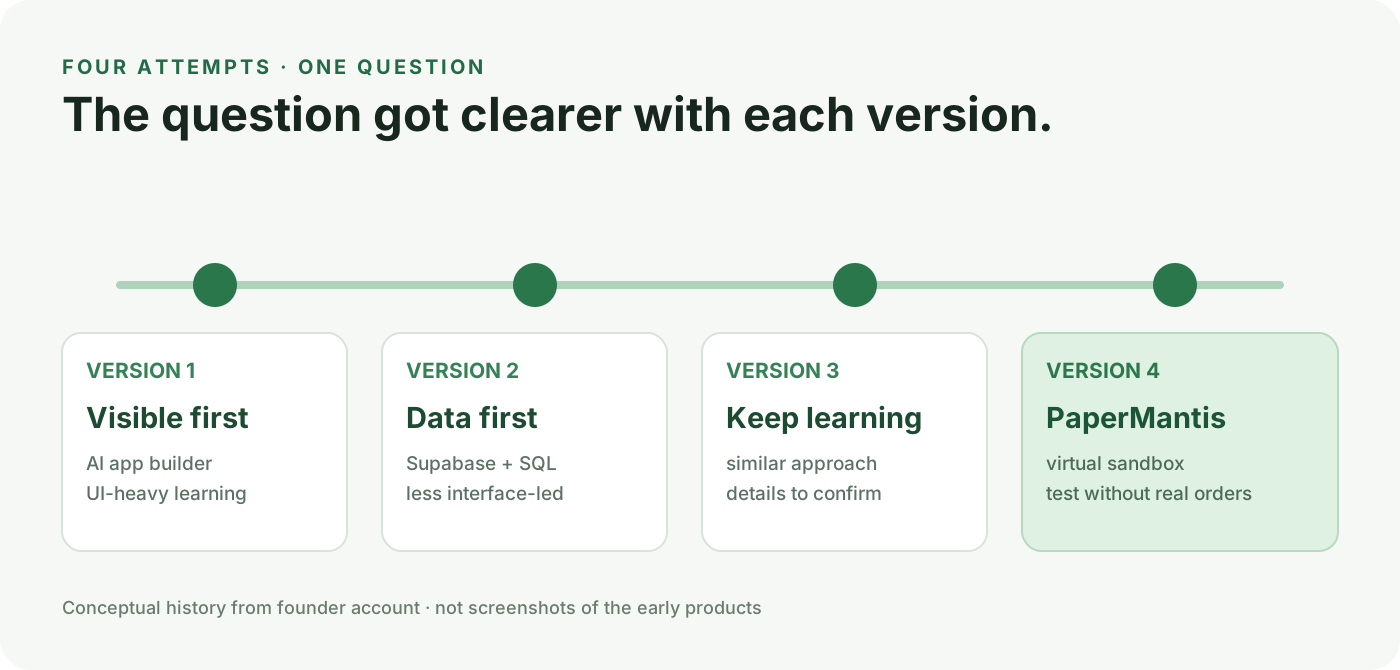
The first version was made with an AI app-building tool. It was not the tool I needed for the job I was actually trying to do. More honestly, I was not yet clear enough about the job either. I am a designer, so I spent a great deal of time on the visible interface. A screen I could look at made the project feel real. I had not spent enough time understanding the underlying market logic and order books.
There is a small irony in this: I was trying to find an edge, and my first competitive advantage was apparently adjusting the padding on a dashboard.
The middle versions taught me what the screen could not
The second version leaned more on a Supabase database and SQL. I spent more time working with the data and less time depending on the interface to tell me what was happening. The third attempt was similar. I do not want to invent a neat feature-by-feature evolution between them just because “version three” sounds like it ought to have a dramatic lesson.
What did change was my interest in prediction markets. At first the appeal was the possibility of finding a useful pattern. Over time I became more interested in the market itself: what a price meant, which observation arrived before a decision, how a result was settled, and how easily a backtest could flatter a rule that would fail later.
That last worry is not unique to my project. Researchers have described the probability of backtest overfitting: when many variations are tried on old data, the best-looking one can owe part of its shine to the search itself. The paper is about investment simulations in general, not a validation study of PaperMantis. It gave me a useful name for the trap I was already trying to avoid.
That made the original side-hustle framing feel too small for the question. I wanted a safe place to experiment with strategies and look for an edge, but I did not want to risk real money just to learn the basics. I also did not want to build a huge trading stack before I knew whether the idea deserved one.
The fourth version has a different job
PaperMantis became a research sandbox for prediction-market backtesting and paper trading. I can test a rule on recorded markets, keep its assumptions visible, and—where the product and data support it—watch a frozen version on later markets with virtual money. It does not place real orders. A historical gain is not cash profit, and a promising pattern is not proof of a durable edge.
I designed and built the product end to end with AI assistance. The work moved far beyond drawing screens: the data path, testing logic, product decisions and site launch all became part of the same project. The result is something people can use and question, even while I keep changing parts of it.
I still do not have an “AI found the secret strategy” ending. I have a tool for asking a better question: can a rule found in old data survive a fairer check and then new markets? That is a much more interesting place to start sharing what I build.
If you try PaperMantis, I would like to know where the product makes an assumption look too certain. Those are exactly the places I want to improve.