
Prediction markets
A 60% market is not offering you a 40% profit
A 60% prediction-market headline can hide a 64¢ ask, a thin order book and a very ordinary amount of risk.
The prediction-market card says 60%. The small green button says Buy Yes.
My brain wants to finish the sentence for me: If it happens, I make the other 40%. Very considerate of my brain. It has skipped the price at which I can actually buy, the fee, and the possibility that the outcome does not happen.
On Polymarket's own pricing explainer, the displayed probability can be the midpoint between the best bid and ask. Its example is a 34¢ bid and a 40¢ ask producing a displayed 37%. When the spread exceeds 10¢, the display uses the last traded price instead. So the big number is not necessarily an offer I can execute at that price.
Here is a hypothetical market with a displayed 60%, a 56¢ best bid and a 64¢ best ask. I can buy a Yes share from the visible ask at 64¢ if that size is still there. If Yes wins and this contract settles for $1, the gross gain is 36¢ per share before fees. If No wins, the entire 64¢ entry can be lost. The 40-point space beside the display was never a free margin.
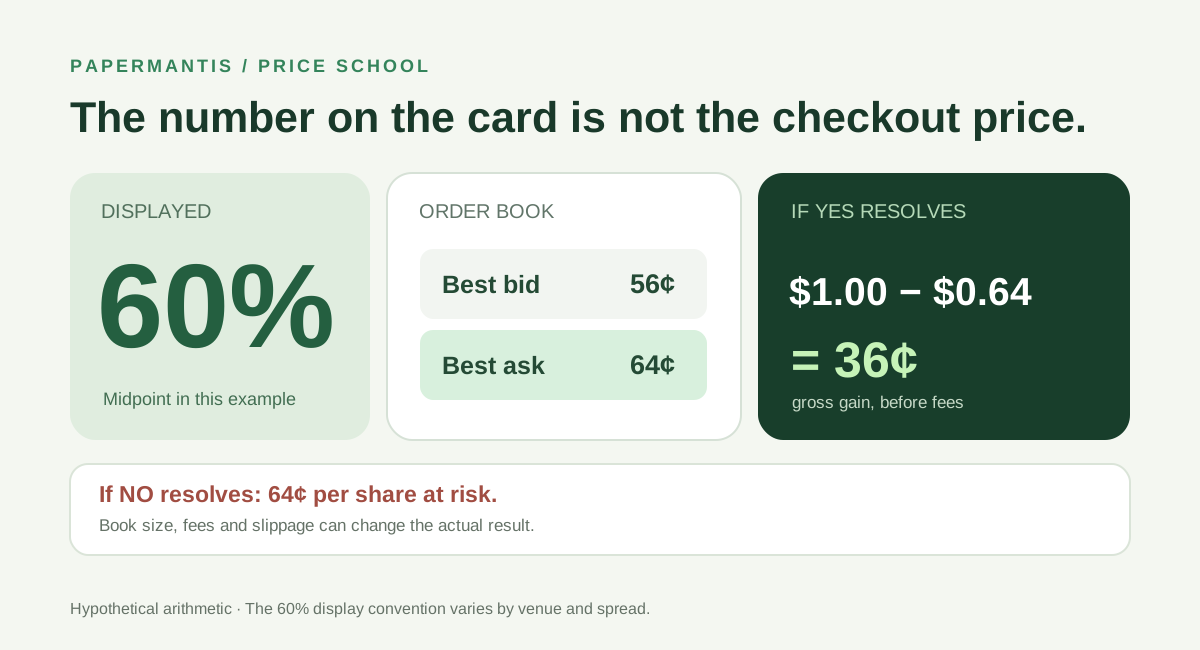
The order book gets a vote
Even the 64¢ ask is only the best visible offer at one moment. It may contain fewer shares than I want, disappear before an order reaches it, or be followed by higher asks. Polymarket's liquidity explainer explicitly warns that a desired size may move the price significantly or fail to trade at all.
The other number people often miss is the exit. Buying Yes at 64¢ and later seeing a 70¢ displayed price does not guarantee I can sell at 70¢. If the best bid is 66¢, that is the immediate visible counterparty price, subject again to size and change. The chart is useful context. The bid and ask describe a transaction more directly.
One number became four numbers and none of them is the guaranteed result. The tidy card feels a little less tidy now. That is also the moment it becomes useful.
What would make it an edge?
Suppose I think the outcome's true chance is 70%. That belief alone is not enough. At a 64¢ ask, the simple before-fee expected value of a $1 binary payout would be 70¢ − 64¢ = 6¢ per share. If my probability estimate is wrong, fees and slippage exceed six cents, or the settlement rule differs from what I assumed, the supposed advantage can disappear.
I would want the contract rule, current book, a reason for my 70% estimate and a plan for size before calling that an edge. A beautiful “60%” badge supplies none of those. The CFTC's consumer explainer also makes the simple point that purchase price, fees and other costs affect the return on a binary contract.
The next time I see a market at 60%, I want to read it as a question, not as a coupon. What is the ask? How much is there? What settles the contract? What would have to be true for my estimate to beat that price?
You can run a historical rule in PaperMantis Builder and inspect the recorded quote used for a simulated entry. It is a way to test an idea with virtual money, not a claim that a live order would fill at that price.