
Building PaperMantis
The $350 that was not a trading result
A $350 rise in my PaperMantis paper-trading Portfolio was a virtual top-up, not prediction-market strategy profit. The accounting needed a clearer story.

At one point my PaperMantis Portfolio had $350 more in it. I would love this to be the start of a story about a paper trading strategy. It is a story about a virtual top-up.
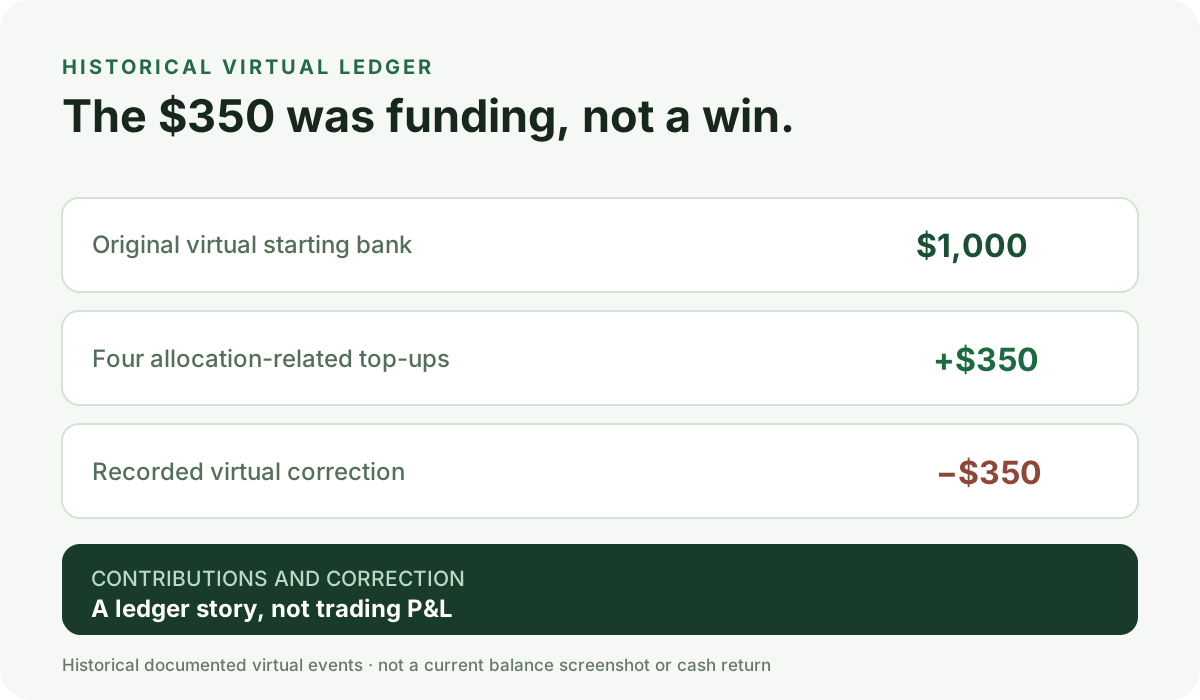
The earlier virtual-money model gave each paper strategy its own allocation. That made one kind of accounting simple: a line could not spend beyond its assigned budget. It made another part confusing. As I added lines, four virtual top-ups totaling $350 were used to fund the extra allocations. The Portfolio's total bank grew, but no strategy had earned that money.
The number needed a label
If contributions, open stake and trading profit sit too close together, a higher balance can look like a win. That is especially risky in a product where the whole point is to test whether a rule works. I asked for the original $1,000 virtual starting bank to stay clear and for adding another experiment not to require a new line-by-line funding ritual.
The model moved to one shared virtual cash pool. A new active strategy keeps its frozen rule and stake setting, but a new entry draws from the same available cash as other active strategies. A fixed dollar stake stays fixed unless I edit its future stake; a frozen percentage setting calculates its dollar stake from the free cash at each new entry. Open positions lock their cost. If there is not enough free virtual cash, the next entry is skipped. When a supported virtual sale or official settlement occurs, proceeds return according to the Portfolio's accounting rules. A strategy result and a contribution are different ledger events.
The $350 was reversed with a recorded virtual withdrawal. The earlier funding events were not deleted, and old trades were not rewritten as if they had always used the new shared model. That history matters. A clean-looking number is less valuable than an account I can explain.
A larger balance is only impressive after I know where the extra money came from.
What I would want a stranger to see
The current Portfolio has evolved beyond that initial correction. The starting bank and a fixed dollar stake for future entries can be edited; a percentage stake remains frozen. A paused line keeps its history, while an archived line follows isolated accounting. Those are separate choices with separate effects. None should turn a funding change into trading P&L.
This is the design lesson I took from the $350: when I show a result, the reader needs to tell what the strategy did from what I did to the account. In a virtual-money product, that distinction is part of the research, not an accounting footnote.