
Prediction markets
Being right nine times can still lose money
A 90% prediction-market win rate can still lose money. Nine correct calls, one wrong call, and the entry price explain why.

Nine green ticks. One red tick. A 90% win rate. It sounds like a prediction-market strategy I would want to tell people about.
I can already see the celebratory screenshot. The receipt is less photogenic.
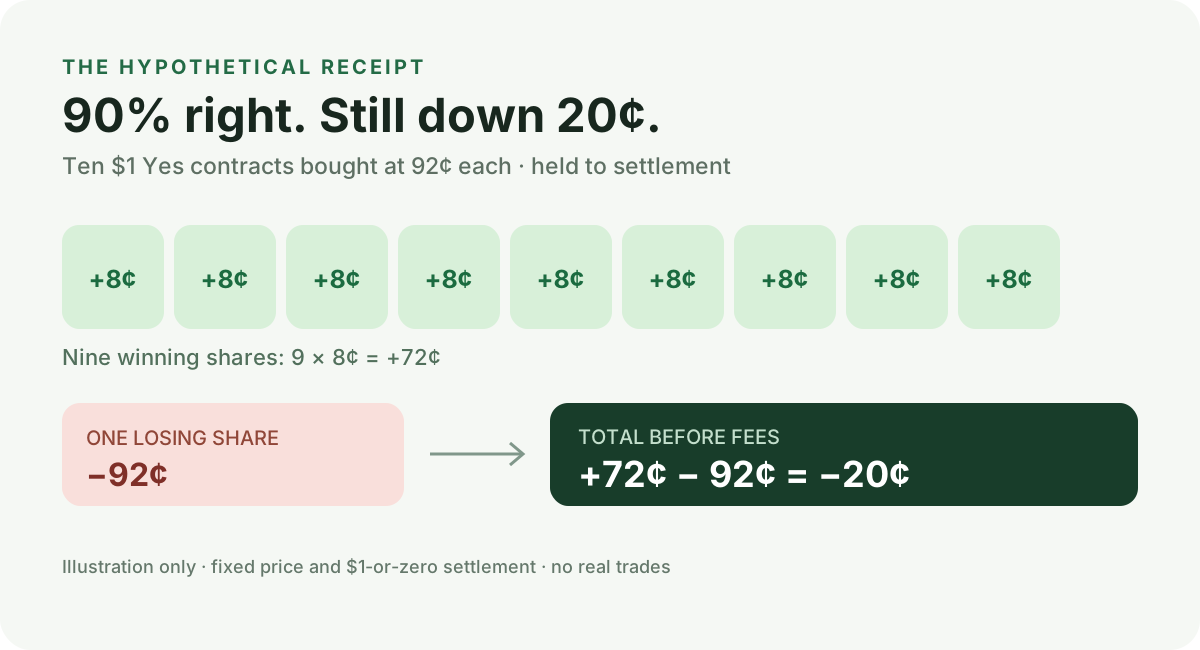
Imagine buying one Yes share in each of ten independent, hypothetical $1 binary contracts. Each share costs 92¢. Nine resolve Yes; one resolves No. Every winner returns $1, so each produces 8¢ of gross gain. The loser returns nothing and costs 92¢.
Nine times 8¢ is 72¢. Subtract the 92¢ loss and the ten trades finish 20¢ down before fees. The prediction was correct nine times out of ten. The purchase price still made the series a losing one.
The price is part of the prediction
The CFTC's event-contract explainer describes the basic $1-payout arithmetic: profit on a winning binary contract is the payout minus its purchase price, while a wrong position can lose the purchase cost. Taxes and fees can change the result. I am using that simple structure here, not claiming every venue or contract has identical terms.
If I really believed these Yes outcomes had a 90% chance each, paying 92¢ would give a simple expected payout of 90¢ for every 92¢ spent. That is negative 2¢ per share before costs. A 90% belief can be well calibrated and still be a bad price at 92¢. Conversely, a lower hit rate can coexist with a good purchase if the price is low enough relative to a defensible probability estimate.
The example's ten outcomes are not proof that the real chance was exactly 90%. A small run can be lucky or unlucky. It is a clean way to expose the missing question behind a win-rate claim: what did each correct answer cost?
The second receipt
Real trading adds more lines. Could I actually buy ten shares at the price I saw? Would the order book have enough size? Would I sell before resolution rather than wait for the $1 payout? Polymarket's liquidity guide says a desired amount may move the price or fail to trade without willing counterparties. A displayed number alone does not answer that.
This is why a cropped record of nine wins tells me less than a plain ledger. I want entry prices, sizes, costs, exits, outcomes, and the trades that did not fit the victory collage. If the claim is about a repeatable edge, I also want to know how the rule was chosen and whether the record includes every eligible attempt.
Being right matters. So does what I paid to be right. The number I would put in the headline is not 90% wins; it is the result after the whole receipt has been read.
If I test a rule in PaperMantis, I want to read its virtual P&L beside the win rate rather than treating the win rate as the result. The historical simulation is still a model, but at least those two numbers answer different questions.